

Luigi Del Bianco’s Italian Roots: The Mount Rushmore Carver from Friuli
Documented family tree & key facts
Luigi Del Bianco — chief carver of Mount Rushmore. b. Meduno (Pordenone), Friuli, 1892; d. Port Chester, New York, January 1969.
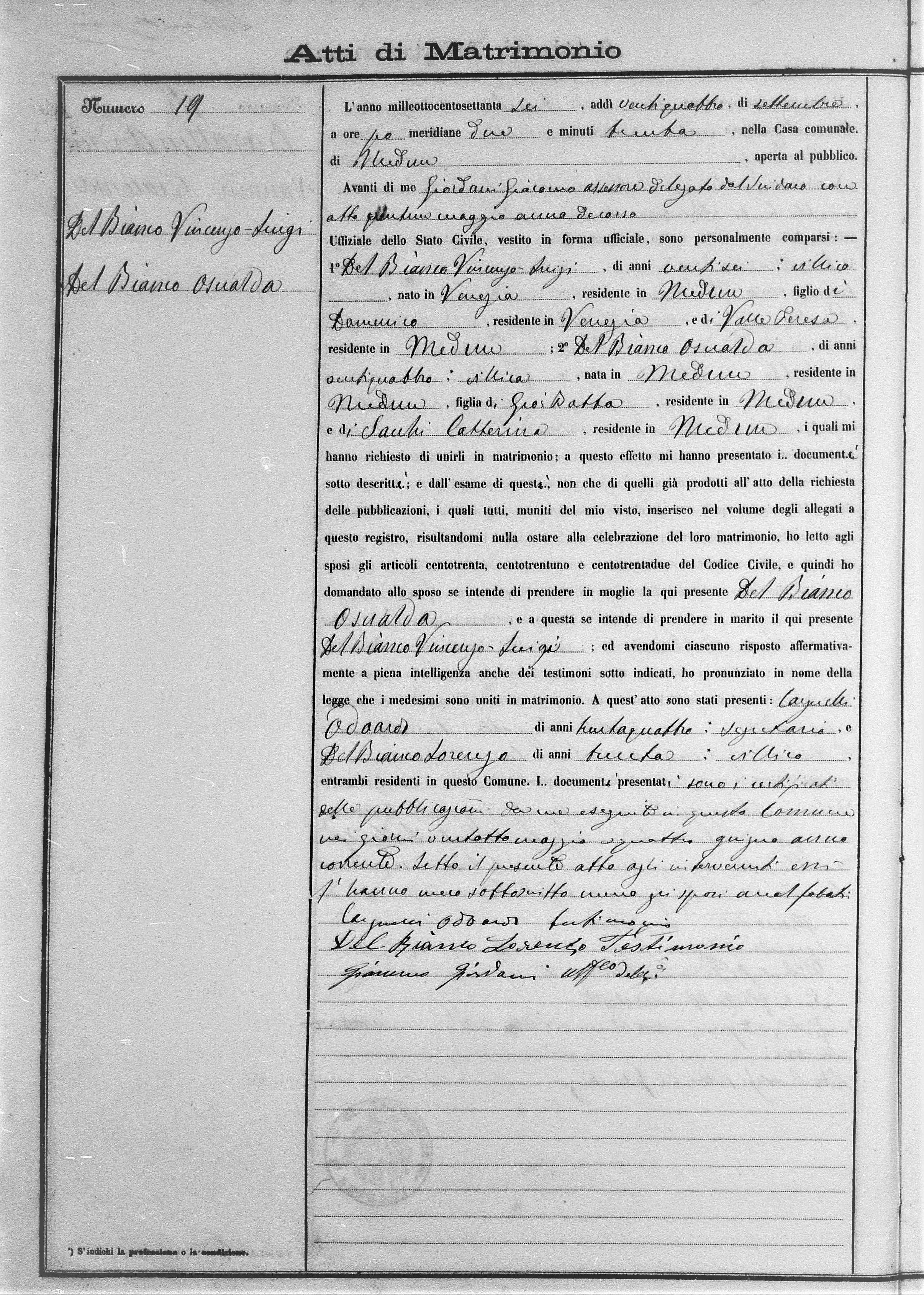
Parents: Vincenzo Luigi Del Bianco (b. Venice, 1850) × Osvalda Del Bianco (b. Meduno, 1852), m. Meduno, 24 Sep 1876.
The line — Del Bianco, of Meduno (Pordenone), Friuli
Domenico Del Bianco × Maria Teresa Valle — furthest documented
↓
Vincenzo Luigi Del Bianco (b. Venice, 1850)
Giovanni Battista Del Bianco × Catterina Sacchi — furthest documented
↓
Osvalda Del Bianco (b. Meduno, 1852)
↓ (Vincenzo × Osvalda, m. Meduno, 24 Sep 1876)
Luigi Del Bianco (1892–1969)
His wife’s family — Cardarelli, of Abruzzo
Luigi married Nicoletta Cardarelli, whose line is documented too: Gennaro Cardarelli (b. Villetta Barrea, L’Aquila, 6 April 1861) × Maria Giuseppa Murano (b. Buccino, Salerno, 28 August 1864; m. Buccino, 24 July 1886).
Worth knowing
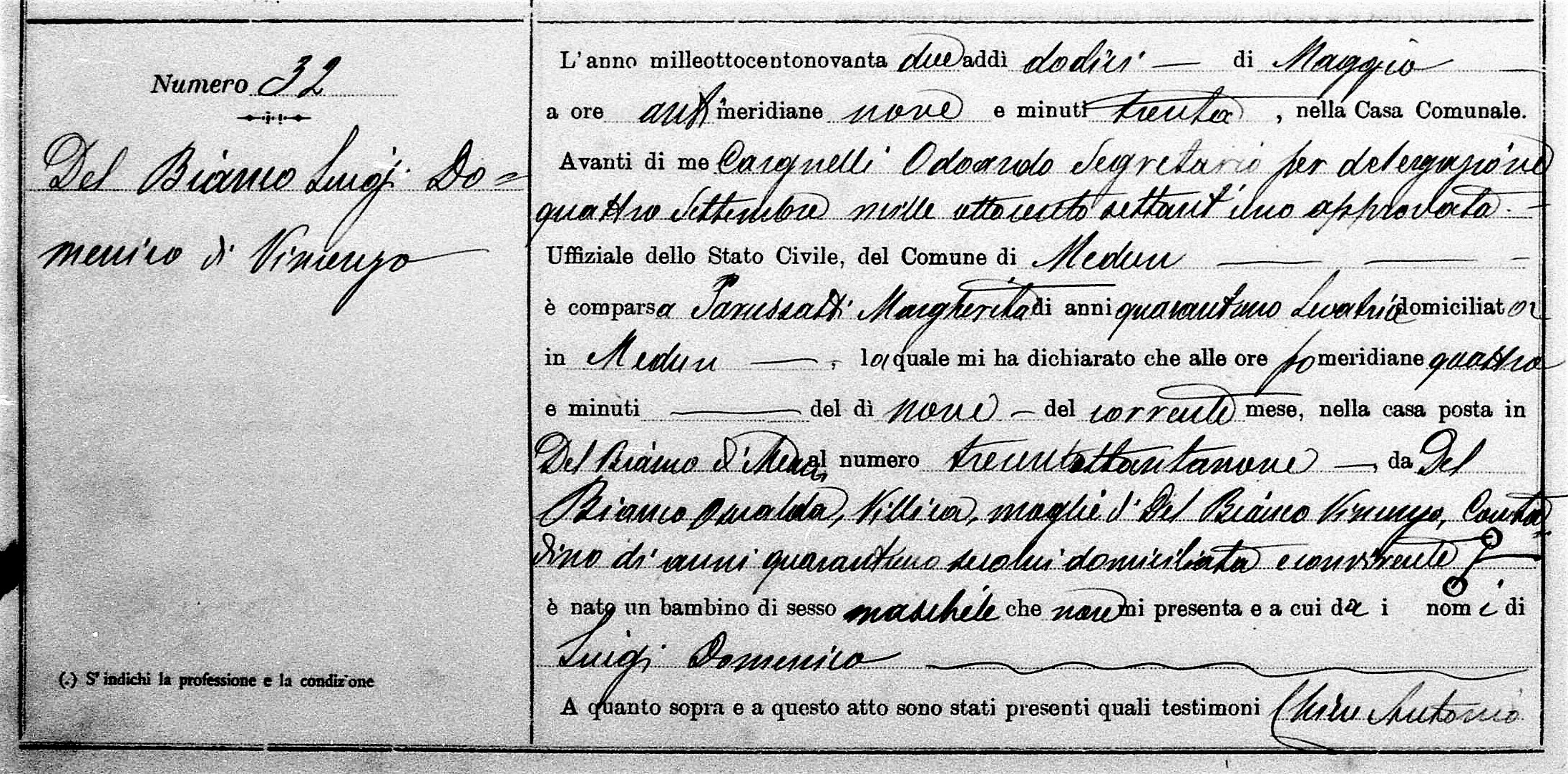
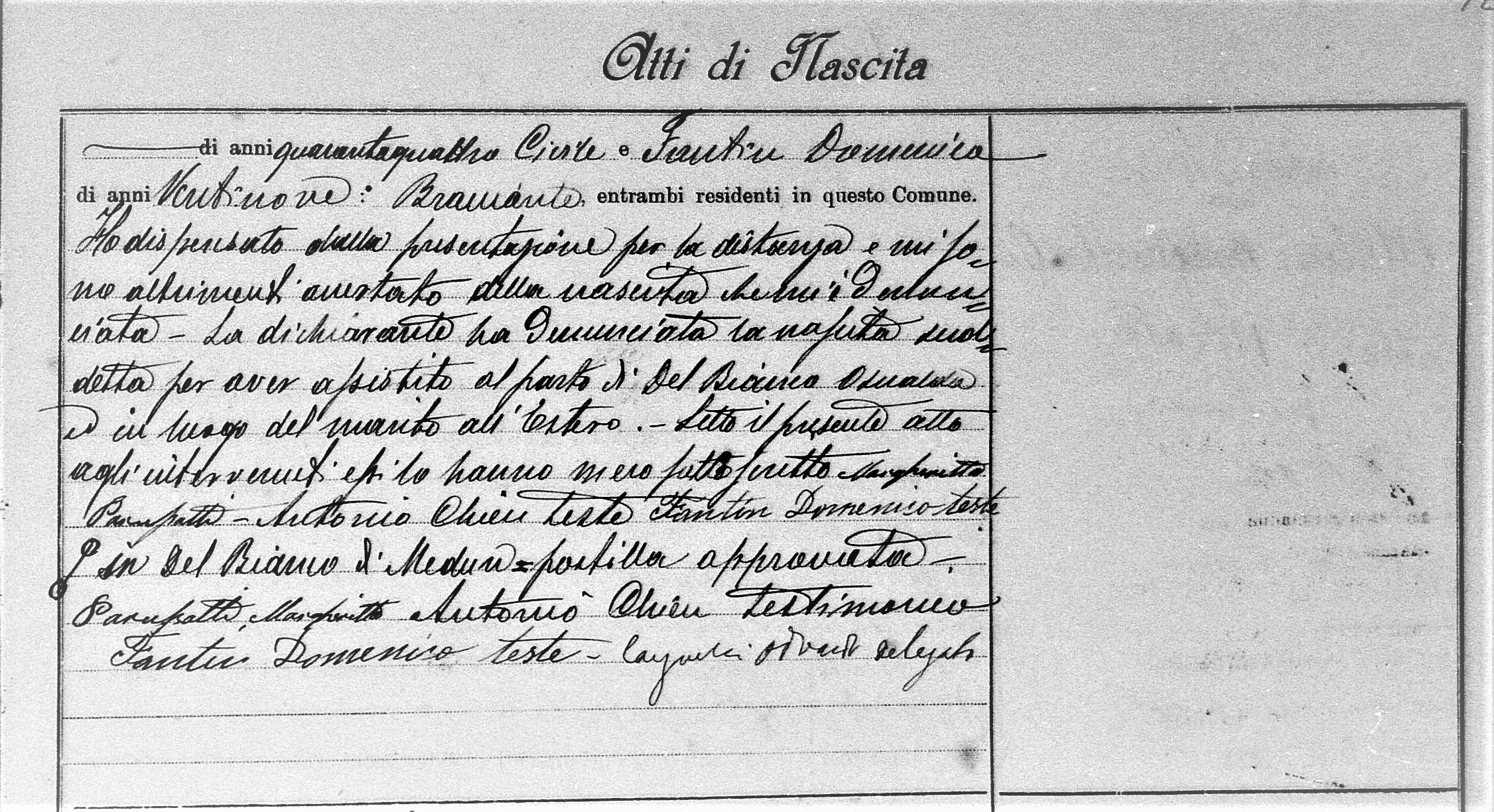
Family legend held that Luigi was born aboard ship off Le Havre in 1892; the civil register of Meduno records his birth in the town itself — the record settling the legend.
Documented by original acts (civil registers of Meduno in Friuli; Cardarelli/Murano acts of Abruzzo; U.S. census). Names earlier than those marked “furthest documented” are not yet proven and are left out.
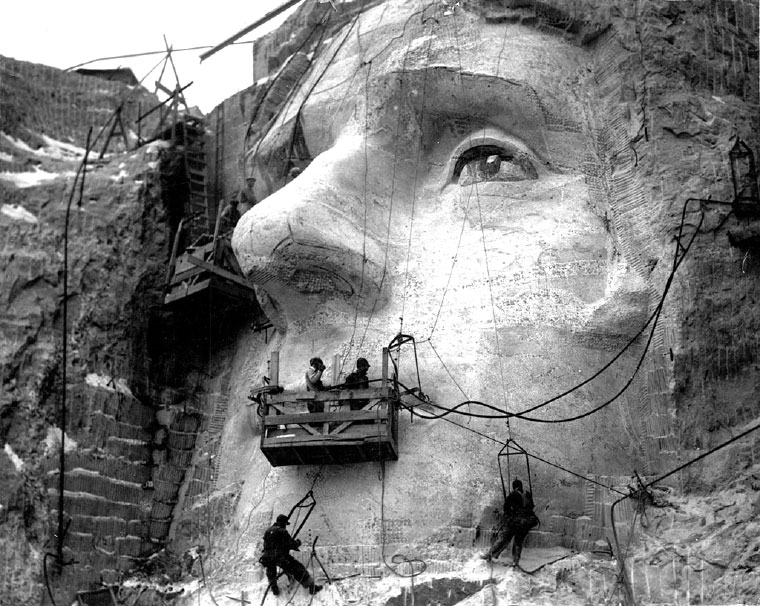
The four presidents of Mount Rushmore were carved into the granite of the Black Hills of South Dakota under the direction of a man from a small town in Friuli. Luigi Del Bianco was the chief stone carver of the memorial, responsible for the finest detail work — above all the expression in the eyes of the figures — from 1933 to 1940.
A son of Meduno
Luigi Del Bianco was born in Meduno, in the province of Pordenone, son of Vincenzo and Osvalda Del Bianco, who had married there on 24 September 1876. His father, Vincenzo Luigi Del Bianco, was born in Venice in 1850, son of Domenico Del Bianco and Maria Teresa Valle; his mother, Osvalda, was born in Meduno in 1852, daughter of Giovanni Battista Del Bianco and Catterina Sacchi. Friuli was a land of emigrant stone-cutters and mosaic-workers, and Luigi carried that craft to America.
On this point the documents settle a persistent legend. Several accounts — repeated in biographies and handed down in the family itself — say that Luigi was born aboard a ship off Le Havre in May 1892, as his parents returned from America to Italy. The civil birth register of Meduno records otherwise: his birth is entered there, in the town, and it is that act that fixes the place. The crossing at Le Havre belongs to family memory; Meduno belongs to the record.
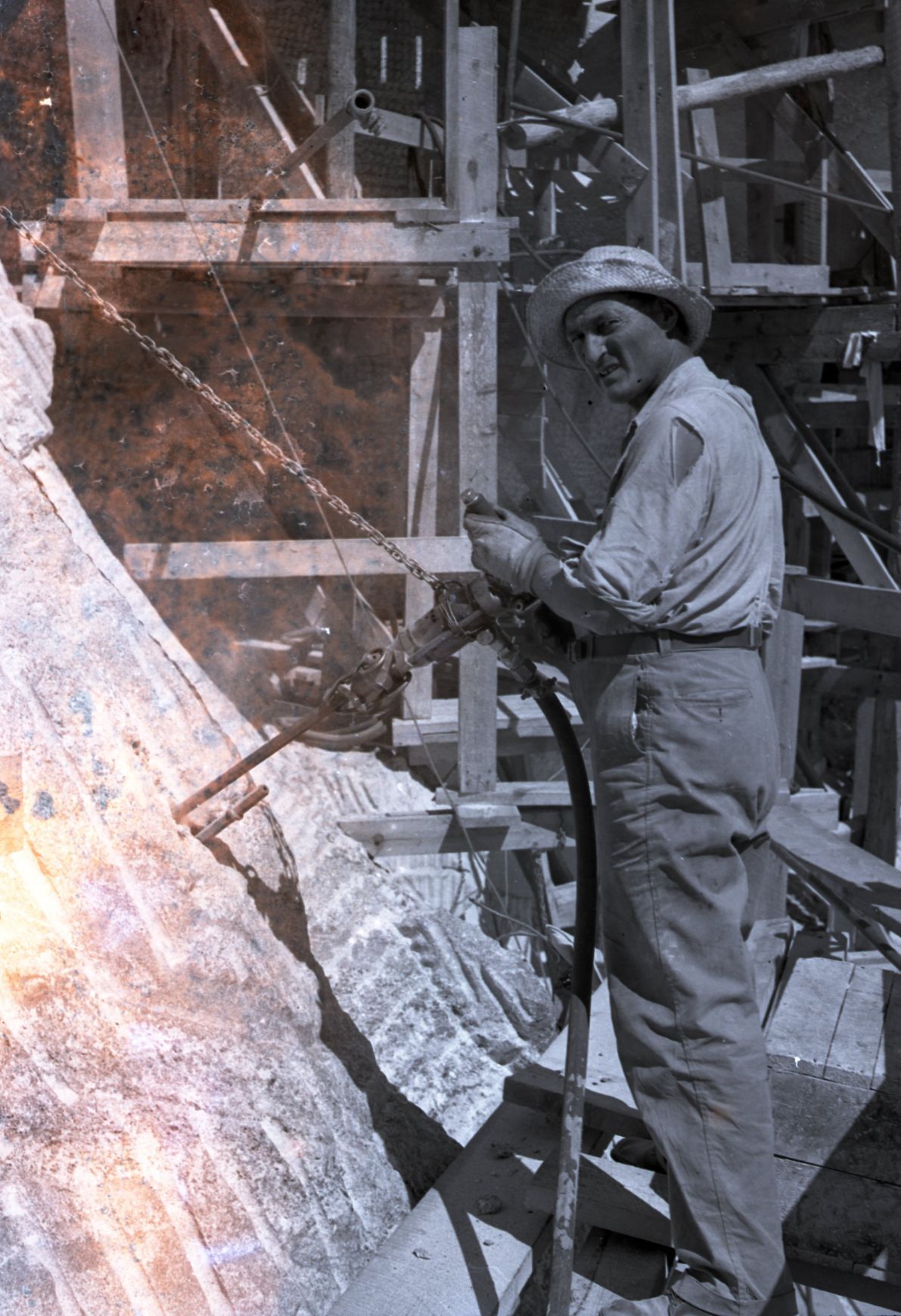
Luigi Del Bianco married Nicoletta Cardarelli at the Holy Rosary church in Port Chester, New York. He died on 19 January 1969 of silicosis, contracted from a lifetime of breathing stone dust — the same craft that had raised him from a Friulian village to the granite of Mount Rushmore.
The grandparents’ records — Meduno
Two civil death records from Meduno reach back into the family Luigi came from. His grandfather, Domenico Del Bianco, was born in Venice and worked as a carpenter before settling in Meduno, where he died in 1894 at the age of eighty-four; his wife, Maria Teresa Valle, of an old Meduno family, followed him in 1907, aged eighty-seven. What makes the second record remarkable is the hand that declared her death: Pietro Del Bianco, a tagliapietra — a stone-cutter. The records reach back one generation further still: Domenico was the son of Giacomo Del Bianco, and Maria Teresa the daughter of Domenico Valle and Lucia Pastor — Luigi’s great-grandparents, farming families of the Meduno hills whose names survive only because these two acts were written down. Two generations before Luigi shaped the faces of Mount Rushmore, the chisel was already the family’s craft.


A boy with a chisel
The family’s own account traces the gift to his boyhood. As a small boy, they say, Luigi haunted his father’s wood-carving workshop in Meduno, and the men of the village would marvel at how curious the child was; convinced of his talent, Vincenzo is said to have taken the thirteen-year-old to Austria to train under a master stone-carver, and then to Venice to study. What the record fixes with certainty is the departure: in 1910, at eighteen, Luigi boarded the La Touraine at Le Havre and sailed for America.

From Meduno to American granite
When the First World War broke out, Luigi crossed the ocean back to Italy of his own accord, to fight for his homeland. He returned to America in 1920, worked a year in the granite sheds of Barre, Vermont — one of the great gathering-places of Italian stone-carvers in the New World — and then settled in Port Chester, New York. There he met and married Nicoletta Cardarelli, born in Port Chester on 6 December 1902, the daughter of Gennaro Cardarelli and Maria Giuseppa Murano — a family whose roots the records trace across two regions of southern Italy. Her father, Gennaro, was born in 1861 at Villetta Barrea, in the mountains of Abruzzo, the son of the village mason Giovanni Battista Cardarelli; her mother, Maria Giuseppa Murano, was a girl of Buccino, in Campania, born there in 1864 to the butcher Michele Murano and his wife Vincenza. The two married at Buccino on 24 July 1886, and the family emigrated to New York before the century was out. The Cardarelli belonged to the town’s close-knit community of Italian stone-carvers — Nicoletta’s sister Pasqualina had married the stone-cutter Alfonso Scafa in 1910. Luigi and Nicoletta would raise five children: Teresa, Silvio, Vincenzo, Cesare and Gloria.

Nicoletta’s family, in the records
Nicoletta’s own family is documented as fully as Luigi’s. These records trace the Cardarelli and the Murano from two villages of the Italian South to Port Chester, New York.


“Bianco” and Borglum
It was that same brother-in-law, Alfonso Scafa, who changed the course of Luigi’s life — for it was Scafa who introduced him to the sculptor Gutzon Borglum. Borglum took to the young Friulian at once, calling him affectionately “Bianco”, and the two would work together out of Borglum’s studio in Stamford until the sculptor’s death in 1941. Through the 1920s Luigi assisted him on Stone Mountain in Georgia and on the Wars of America memorial in Newark, New Jersey; with his strong build and classic Roman features, he is said to have modelled for twenty of the figures on the Newark bronze.
The face of a nation
In 1933 Borglum made Del Bianco chief carver of Mount Rushmore, entrusting him with the “refinement of expression” — the detail and the life of the four faces — at $1.50 an hour, a considerable wage in the depths of the Depression. It was Bianco who carved the living eyes of Abraham Lincoln, shaping them so they would read correctly even from miles away. And it was Bianco who saved the face of Thomas Jefferson, patching a crack in the lip with a foot-deep block of granite pinned in place — the only patch on the whole monument, and one almost impossible to see. The writer Judith St. George singled him out as one of the finest carvers ever to work on Rushmore, the rare man whose skill Borglum could truly rely on. In 1935 Luigi brought Nicoletta and their three sons — Silvio, Vincent and Caesar — to live at Keystone; the family still tells how the boys attended a one-room schoolhouse, rode horses, swam in the streams, and were even made blood brothers of the Sioux.
Home to Port Chester
By 1941 the money for the memorial had run out, and the coming of the Second World War closed the mountain for good. Luigi returned to Port Chester and to his own stone shop, where he carved some five hundred headstones out of rough Vermont marble. He never forgot his origins, making pilgrimage after pilgrimage back to Meduno, whose museum still keeps photographs and mementoes of its native son; and Port Chester remembered him too — the dapper gentleman in the fedora, a gleam in his eye, walking the Italian quarter of Washington Park and telling the story of his mountain. Asked about it all in 1966, he said he would do it again even without pay: “a great privilege granted me.”
Out of Rushmore’s shadow
For decades his name went unrecorded on the mountain he had helped bring to life. Luigi Del Bianco died in Port Chester in January 1969, aged seventy-six. It fell to his family — his son Cesare, and then his grandson Lou Del Bianco, who told the story in his book Out of Rushmore’s Shadow: The Luigi Del Bianco Story — to win him his due. On 16 September 2017 the National Park Service unveiled a memorial recognising Luigi as the chief carver of Mount Rushmore: a stone-cutter from Friuli, at last named on the American mountain his family’s craft had helped to shape.
A carver from Friuli on an American mountain. Where does your family begin?
Behind the faces of Mount Rushmore stands a stone carver from Meduno, in Friuli — his birth recorded in the parish and civil registers of Pordenone. Your family’s trail is waiting in an Italian archive too. Tell me a little about your family, and I will give you an honest assessment of what is possible.