

Joe DiMaggio’s Italian Roots: A Fishing Village Called Isola delle Femmine

“Where have you gone, Joe DiMaggio?” When Simon & Garfunkel sang the line in 1968, they were reaching for something already lost. Joseph Paul DiMaggio — the greatest baseball player of his age, Marilyn Monroe’s husband, an American myth — was born on 25 November 1914 in Martinez, California, the eighth of nine children of two Sicilian immigrants: Giuseppe DiMaggio (1872–1949) and Rosalia Mercurio (1878–1951).
Both came from the same place — Isola delle Femmine, a tiny fishing village on an islet off the north-western coast of Sicily, in the province of Palermo. And unlike the legend, the beginning of the story is not lost at all: it is written, plainly, in the registers of that village.
A fisherman and a mender of nets
The DiMaggio story begins on 9 December 1897, in Isola delle Femmine, where Joe’s parents were married: Giuseppe DiMaggio, twenty-five, a fisherman, and Rosalia Mercurio, nineteen, whose trade the record gives as “fa le reti” — a maker and mender of fishing nets.
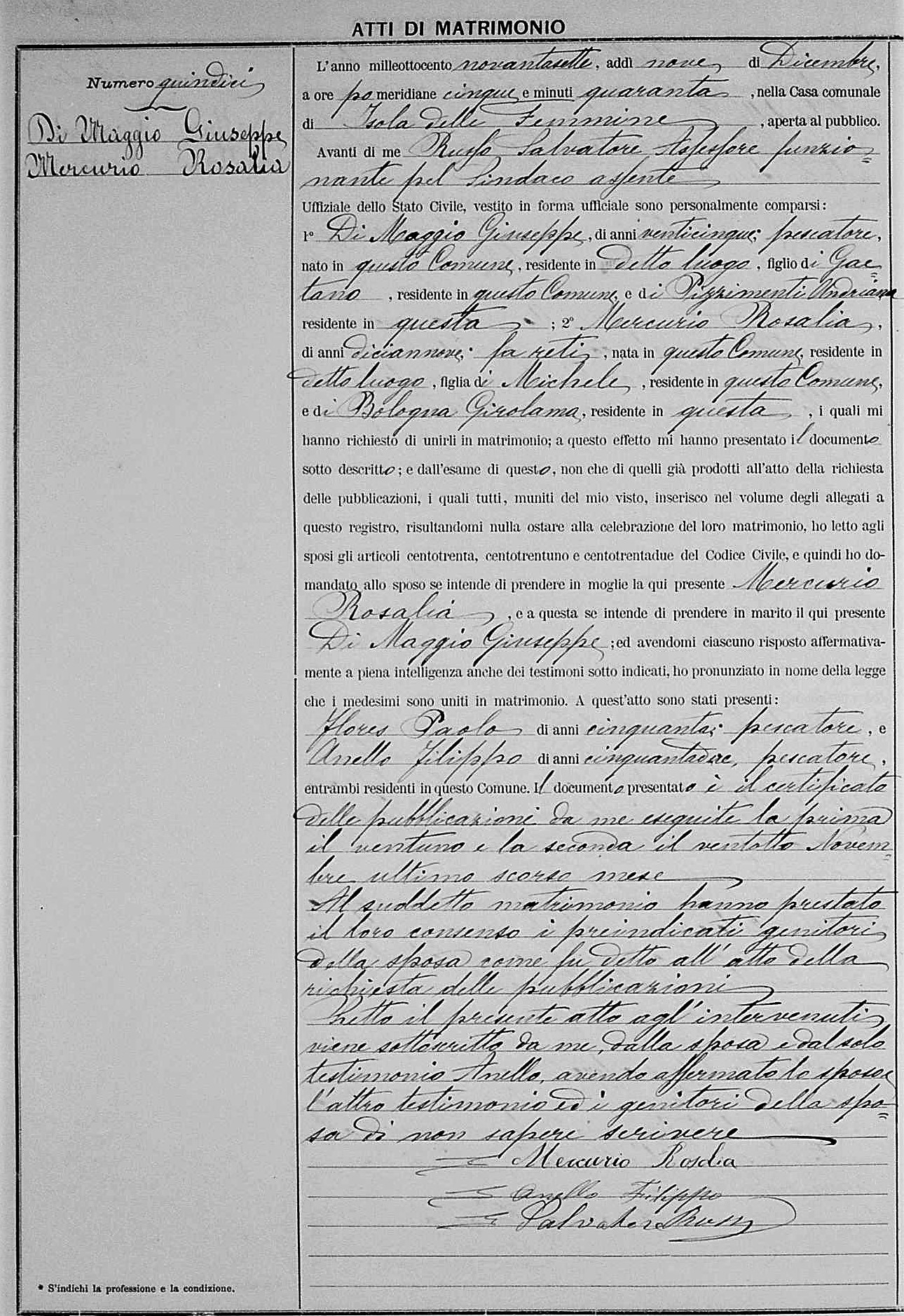
Giuseppe emigrated a few months later, on 9 March 1898, following his father-in-law Michele Mercurio across the Atlantic. By 1902 he had saved enough to send for his wife and their first daughter, Adriana. The family settled first in Martinez, then moved to North Beach in San Francisco, closer to the fishing grounds of the bay.
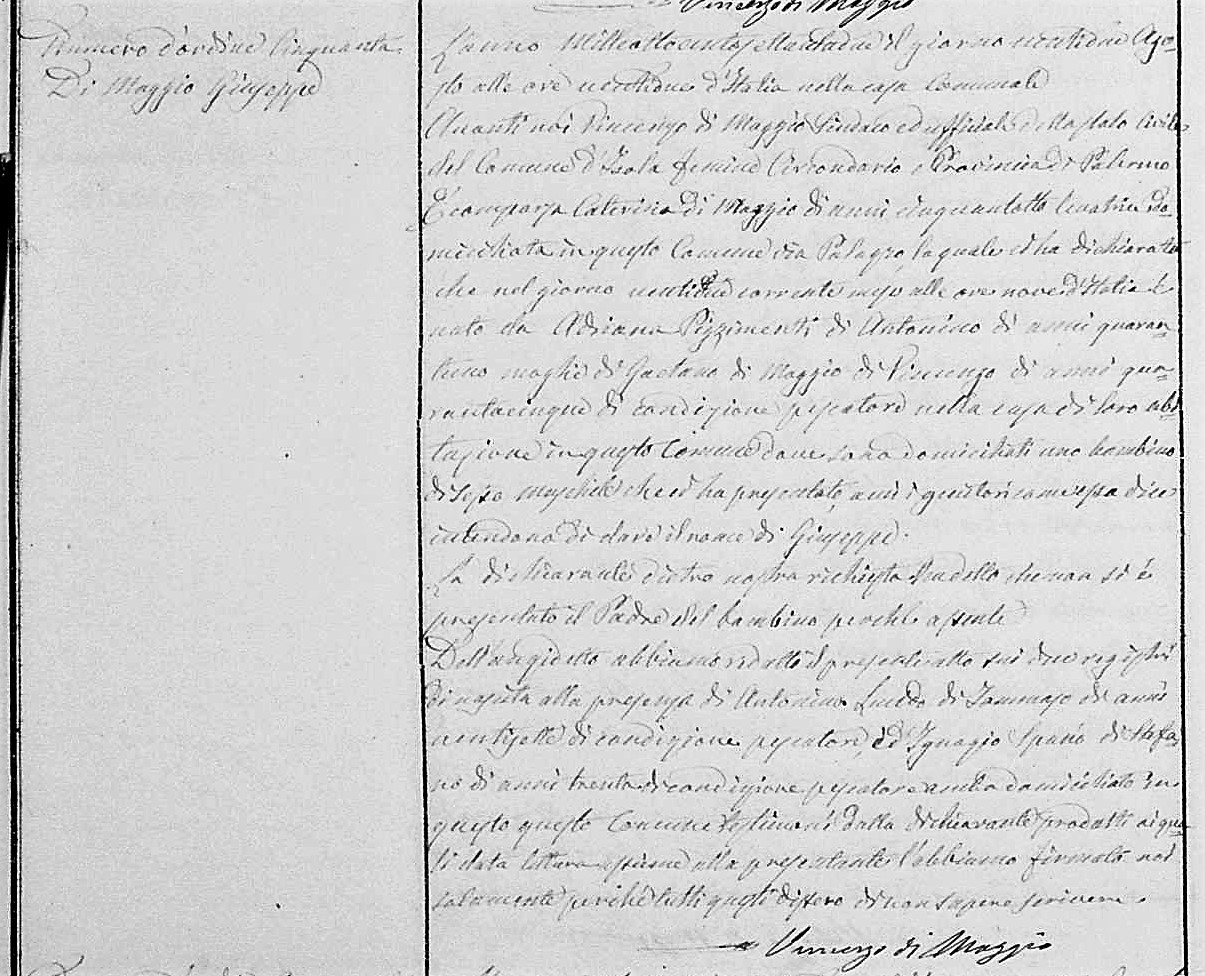
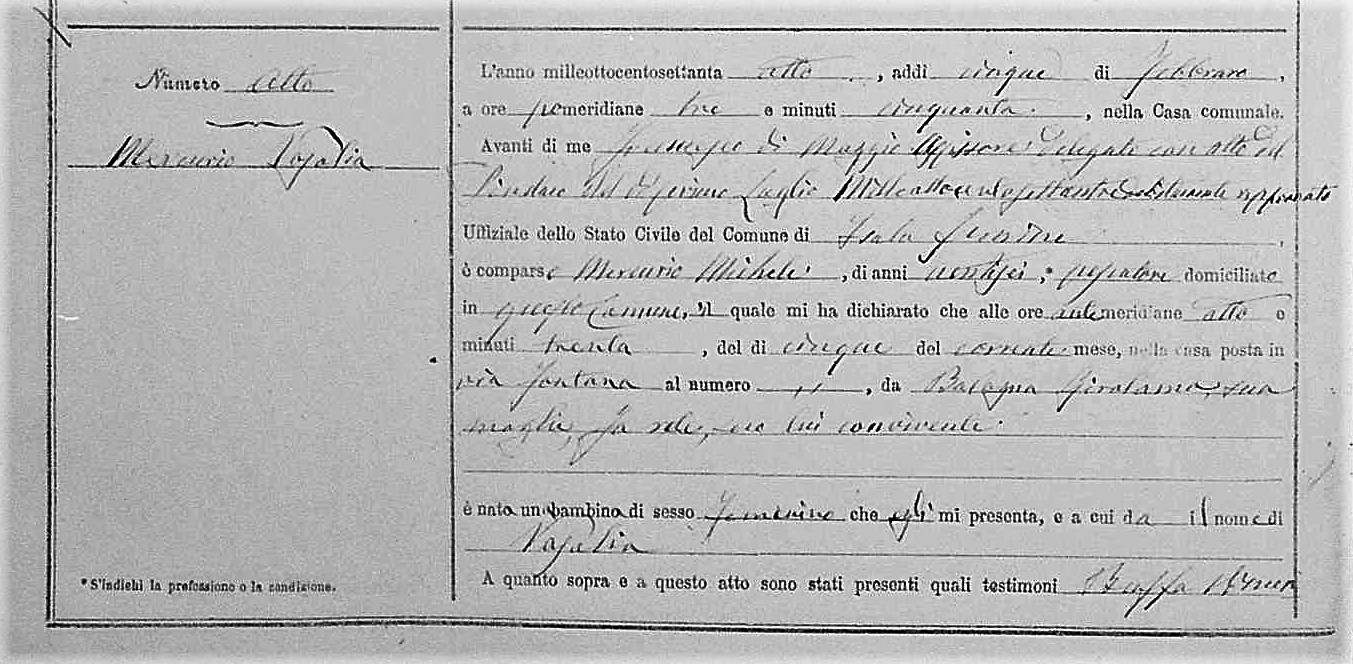
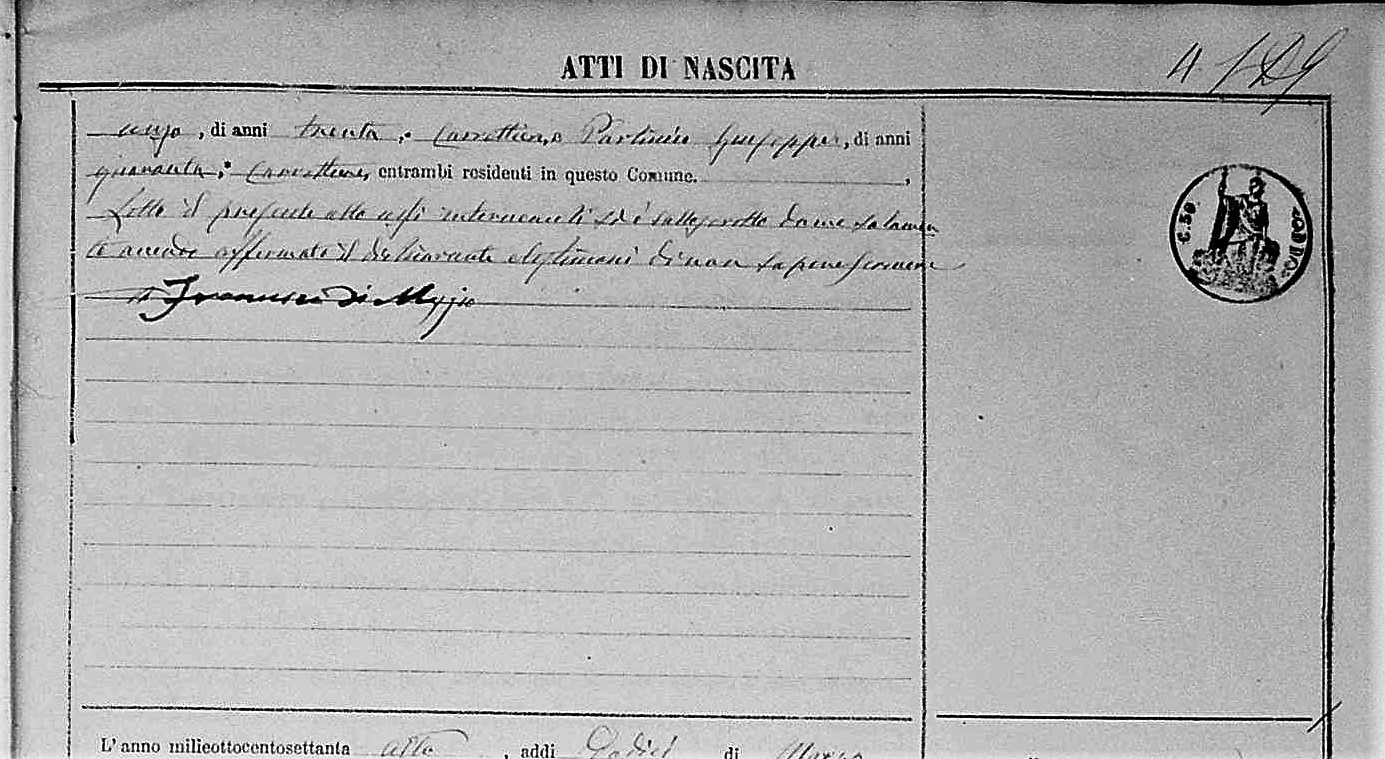
Giuseppe himself was born in Isola delle Femmine on 22 August 1872, son of Gaetano Di Maggio; Rosalia was born there on 5 February 1878, daughter of Michele Mercurio and Girolama Bologna. Each name sits in a register that still exists.
The boat called Rosalie D.
Isola delle Femmine — whose name may descend from the Arabic “Jazira al-Ma’adin,” the island of the mines — was a village of fishermen, and Giuseppe stayed one, casting his nets in the Tyrrhenian before he ever cast them in San Francisco Bay. There is a bitter coda to the immigrant story. After Pearl Harbor, the United States classified Giuseppe and Rosalia, who had never naturalised, as “enemy aliens.” Giuseppe’s fishing boat, the Rosalie D., was seized, and he was forbidden to go near the bay. The father of the greatest ballplayer in America could no longer work. Joe, then serving in the army, learned of it only later.
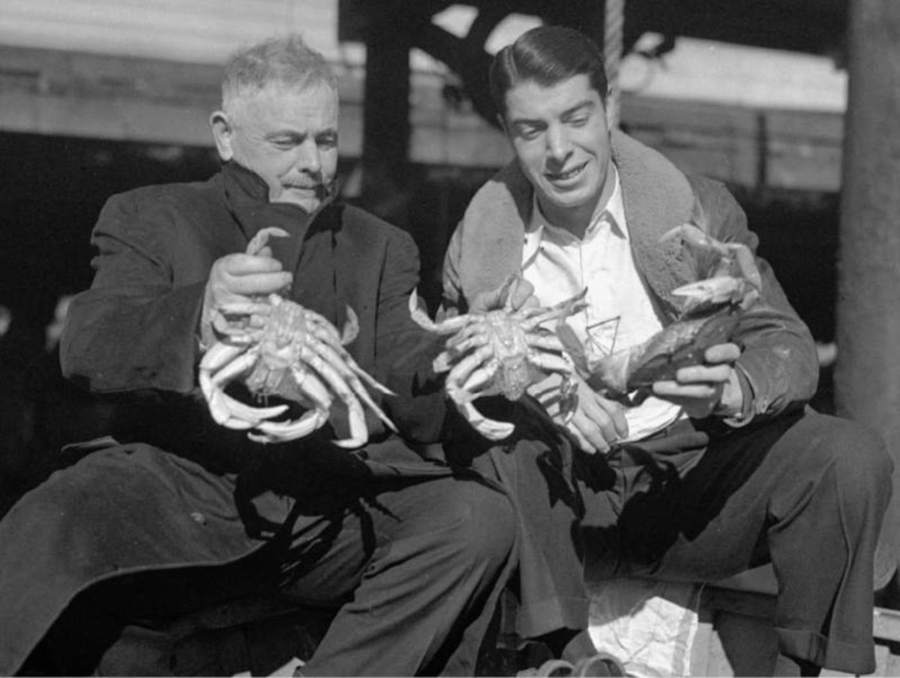
DiMaggio married Dorothy Arnold, and then, in 1954, Marilyn Monroe. Long after their divorce, and after her death, he had fresh roses delivered to her grave three times a week for twenty years. He entered the Baseball Hall of Fame in 1955 and, in 1977, became the first American athlete awarded the Presidential Medal of Freedom. The line the song mourned had a birthplace all along: a fishing island off Palermo.
A famous name, a Sicilian fishing village, and a register that kept the record. Yours is somewhere too.
Behind Joe DiMaggio stands Isola delle Femmine and a marriage recorded in 1897. Your family’s trail is waiting in an Italian archive too. Tell me a little about your family, and I will give you an honest assessment of what is possible.